

The Great AI Disruption: A New Book

Yes, it is for sure a disruption…
If you’ve been following this newsletter for the last few months, you know that we’ve been working on a new AI book, The Great AI Disruption. We just published it, so please get your copy from Amazon now!
The focus is on the impact that AI is already having, and will continue to have, on organizations and how they function. It’s clear that the disruptive power of AI is going to be decisive, so in the book we look at key issues that leaders and managers will face (or are already facing), including how to deploy AI systems that are increasingly autonomous, how to resolve critical contradictions that AI brings forth, and what a new organizational operating system will work for what appears now to be “the Age of AI.”
You probably know that this is our fourth book on AI. In each we have been offering models of how AI will develop, and so far our predictions have been quite sound. We think we’re on target with this one, too. But you be the judge:
Our Argument and Its Evidence
Here is a short summary of what the book says:
In just a few short years, AI has become a major force in business, economics, geopolitics, and society. It’s so common now that it’s a commodity, a mechanical intelligence that individuals, companies, and governments rely upon to expand and augment their cognitive reach into the universe. It’s a tool for efficiency in business, for completing tasks at high speed with high precision. It’s a teacher and a tutor, a maker and a transporter, and a powerful pattern-finder. It’s also a war fighter.
The companies creating AI have attained astronomical market valuations because investors believe that today’s uses for AI are just the beginning of a much more profound transformation of work, the workforce, and all forms of productive capacity. If they’re right, the transformative consequences will be immense.
Yet this extreme concentration also carries significant risks, both because AI might succeed at this, and because it may fail. Government leaders and decision makers will thus have to navigate a narrow passage between alternate forms of possible disaster.
However, AI is not the only technology with such disruptive capability. A large collection of additional breakthroughs are now reaching maturity, and each has the potential to bring significant disruption on its own. Taken together, we call them the “perfect digital storm.” It’s coming our way.
The digital storm has already hit in eastern Ukraine, where warfare is now autonomous as it has never been before, and so with a devastating death toll. Three factors are shaping AI’s battlefield capabilities, and its marketplace capabilities too. The first is speed – AI speeds things up. The second is autonomy – AI makes judgments and takes actions on its own. It’s supposed to adhere to boundaries defined by people, and sometimes it does. The third is asymmetry, which defines how AI creates commercial, military, and geopolitical advantages.
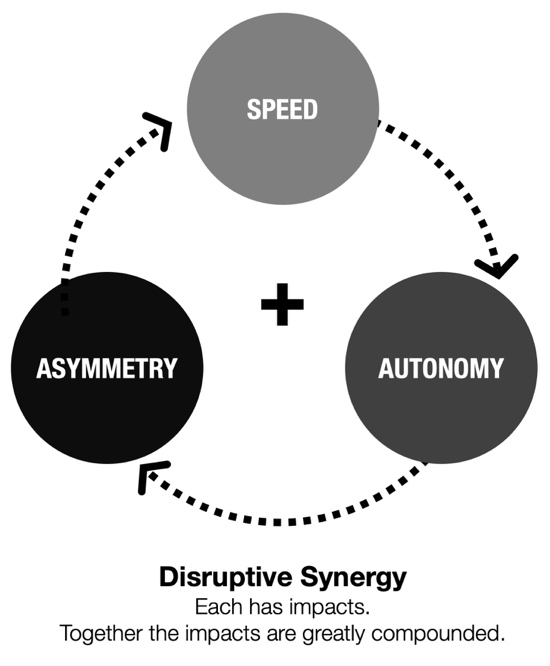
The three operate together in a form of disruptive synergy. And it is because of the power that this combination provides that the development of AI has taken on the character of a runaway train. There is just so much at stake, and so much incentive for both companies and nations to use this power to get ahead, that meaningful limitations on AI seem a remote possibility. A feverish pace of development is much more likely, which will lead soon to AI with much higher levels of capability and disruptive impact than today.
Consequently, military leaders are intently trying to figure out what this all means for security and combat, while business leaders are trying to discern how to harness these capabilities without burning down the house.
The challenge can be defined by five pairs of concepts:
With increasing speed comes increasing risk.
Increased autonomy requires effective governance.
With increasing efficiency comes reduced resilience.
With increasing scale comes increased complexity.
And with accelerated capacity for adaptation to change comes the risk of incoherence and loss of identity.
A major problem that leaders face when confronted with these pairs is the idea that they define immutable conflicts, and thus leaders often revert to the urge to compromise. But now, and especially with the support of AI, we have a different option. AI can help us look for higher level solutions, for the synthesis opportunities that redefine the problem in a very productive manner.
This is one of the key elements of what we define as the operating system for organizations. We thus bring the focus back to our first proposition, that AI transforms what used to be the scarce resource of intelligence into a commodity that everyone now has access to. So if intelligence is not the defining quality of competitive advantage, what is? We suggest that it’s judgment, at scale and at speed.
The capacity to judge conditions more quickly enables leaders to make better decisions faster, to seize initiative more confidently, and to create value more profoundly. These advantages are available to be seized, and we suggest that the concept of the “judgment engine” describes how it works.
There’s nothing exceptional or unique about the engine we described, as it’s more or less what leaders and decision makers have always done. What is significantly different now is that AI augments the entire process, thereby bringing, again, more speed, greater depth of reasoning, greater autonomy, and major potential for asymmetric advantage to be gained. These factors will not be merely incremental, they will be thoroughly disruptive.
We ended the book by describing two different but complementary tools designed to deal with the difficult problems that will surely arise in this disrupted transition era. First, we presented a set of four canvases, thinking tools used with paper and pencil, intended to help you reason through the difficult problems that you may be facing in a concise but rigorous manner.
You can download the worksheets here.
We also introduced Crucible AI, a tool we have developed that does that same thing digitally, and with profound power and thoroughness.
(We have also set up a new company to commercialize Crucible, and you can learn all about it here).
We thus expect that AI will indeed become the transformative technology that its promoters expect it to be, but harnessing AI in this way isn’t going to happen with a chatbot or a GPT. Crucible is a multi-agent AI system that can do it now, and we expect that those organizations that adopt this way of working earlier will gain tremendous advantages over others who procrastinate.
Is there a chance that the scenario of AI’s development and impact that we have portrayed here is an exaggeration? That AI will, in the end, underwhelm expectations? Yes, there’s a chance, but we judge it to be a small one. The advantages that AI affords as documented in the already existing case studies are simply too great to reasonably expect a dud.
A great AI disruption, that’s what we do expect.
Please share your feedback about the book with us.
And contact us if you’re interested in Crucible.
Thanks!