

Digital Twins, IBM, Goldman Sachs,And the AI Bubble
As we foresaw in our recent AI trilogy, the pace of AI’s development is continuing to accelerate. That wasn’t a difficult prediction to make. It nevertheless remains fascinating to see how events are unfolding, and it’s useful to track new trends as the emerge.

At Langdon’s keynote talk to the INCOSE Healthcare Working Group conference in Minneapolis last week, he laid out the likely development path for AI over the coming seven years, highlighted key developments for AI in systems engineering, and presented some strong recommendations to the leaders of the 100+ firms who attended the conference. Among the key ideas … Digital twins are coming to the MedTech industry. Soon you’ll have a customized digital twin of yourself to help manage your health and well-being. That presents enormous issues in engineering, AI, ethics, governance, and policy, all of which will be worked out in the next few years.
In other words, big changes are ahead! All these messages to INCOSE were very well received, and in fact afterwards we heard the very nice feedback that Langdon gave “the best keynote ever at an INCOSE conference.”
Here are a couple more possibly startling bits of info that Langdon covered in the talk ….
IBM Got Mugged
Do you remember the old nickname for IBM, formerly the world’s #1 behemoth computer company? IBM, it was said, stands for “I’ve Been Mugged,” became in its prime, IBM’s fees were so much higher than any other firm.
In February (2026) Anthropic released a version of Claude AI that’s quite capable of programming in that ancient language of COBOL, which is what a lot of very old mainframes are still running. IBM continues to make piles of money supporting these antiquities.
And what happened in February? IBM itself got mugged, losing $35 billion of its market cap on the very day of Anthropic’s announcement. AI is coming for IBM, pretty ironic considering that IBM used to put so much effort into promoting its own AI tool, Watson. Now Watson is far behind, and the disruptors are taking over.
This is yet another indication of the AI disruption coming still further into all facets of economic life.
Goldman’s AI Indices
Another disruption indicator was recently offered by Goldman Sachs, which has now created three new market indices:
One for companies that are likely to benefit from AI
Another for firms that AI will punish
And a third for investors who want to stay away from all that drama and invest in firms that Goldman judges likely to unaffected by AI. The unaffected are also thought to immune to any possible bursting of the AI bubble.
The AI Bubble
Investor sentiment is now divided between those who feel enormous enthusiasm for AI and are convinced of its amazing future, and others who feel that AI investment is just a giant bubble. Both could easily be right, though.
The enthusiasm argument is bolstered by continuing heavy investment, now in the hundreds of billions of dollars per year, and the increasing capabilities of AI. Meta (Facebook), for example, just announced that it’s laying off 8000 more workers so it can, yes, spend still more on AI.
The bubble argument is bolstered exactly by this, by the piles and piles of money that companies continue to pour into AI infrastructure and tools without yet seeing the ROI. So much money is going into AI that if the returns are not forthcoming, then we are certainly headed for a giant bubble popping sound, and probably a global recession.
The last time we saw investment concentration in this was 2001, when massive investments in global fiber optics networks led to overcapacity. Unable to generate an adequate return on investment, a wave of bankruptcies soon followed.
Economic growth requires that capital investment be productive and generate a healthy return. Conversely, overinvestment and inadequate (or even negative) returns mean that capital has been misallocated, and such a misfit at scale causes a growth slowdown or contraction, hence a recession. (See Chapter 3 of Lester Thurow’s book Fortune Favors the Bold for a detailed discussion of these dynamics.)
So the question arises as to whether there is going to be an AI recession in our future. If these huge AI investments don’t turn into significant revenue, then the answer is yes, we will. Both the micro- and macro-economics of AI continue to be a source of wide speculation and thorough amazement. What we’re living through is unlike anything that’s happened in over a century.
Crucible Update
We continue to make excellent progress with the development of Crucible AI, our tool for deep analytics in strategy and innovation. We recently upgraded to ChatGPT 5.5, and the results have been amazing. The idea that Crucible is “McKinsey-in-a-Box” is proving to be a quite valid statement.
We are running ever more difficult workflows, including three notable ones last week. Two were prepared in support of the INCOSE conference. With the guidance of the conference organizers, we created two highly targeted problem statements for the medtech sector, one focused on the future of the Medical Imaging market, and second on Deep Brain Stimulation.
For both workflows we asked Crucible to define the best strategy for the incumbent firms, and also for the startup disruptors. It came back with deep analysis for the future of the market, and recommended development and competitive paths for both the established firms and the upstarts. We got back hundreds of pages of detailed reasoning and very clear recommendations.
Both summary reports are available for the asking – just ping us back and we’ll send them to you. And of course if you’d like a deep analysis of the future of your sector we can do that too, as we did for INWI.
The third workflow we ran was for INWI, a telco provider in Morocco whose leadership was doing a learning trip to Silicon Valley. We ran a workflow for them focusing on their primary strategic dilemma, how to sustain rapid growth, integrate AI into their offers, and sustain quality and reliability while scaling.
When we presented the findings to their Chief Digital Officer, his comment was, “Crucible is like having a Chief of Staff for the CEO, that can do strategic analysis any time, day or night.”
That’s exactly right!
Here’s a concise description of how Crucible works:
“Crucible is not a prompt-to-answer chatbot. It is a governed synthesis system that identifies the real business objectives hidden inside raw problem language. It converts those objectives into explicit tensions, stress-tests them through structured protagonist–antagonist debate, and applies synthesis patterns and protocols to generate resolutions that can survive challenge. Each workflow is managed so that no weak phase leaks downstream. In other words, Crucible does not generate an opinion from a prompt; it conducts an auditable, multi-stage reasoning process that turns ambiguity into robust strategic synthesis.”
That delivers a capability that was also one of the key ideas for the INCOSE participants – Strategy is now REAL TIME. There is no lag time in the market, and you can’t afford to wait months to work out the strategic implications of new developments. With Crucible, you don’t have to. Most Crucible workflows take about 2 hours to run, and produce detailed reports as well as summaries, powerpoints, and five-minute video summaries. A complete package, in other words. (McKinsey-in-a-Box indeed!).
The other punch line for INCOSE was about Disruption:
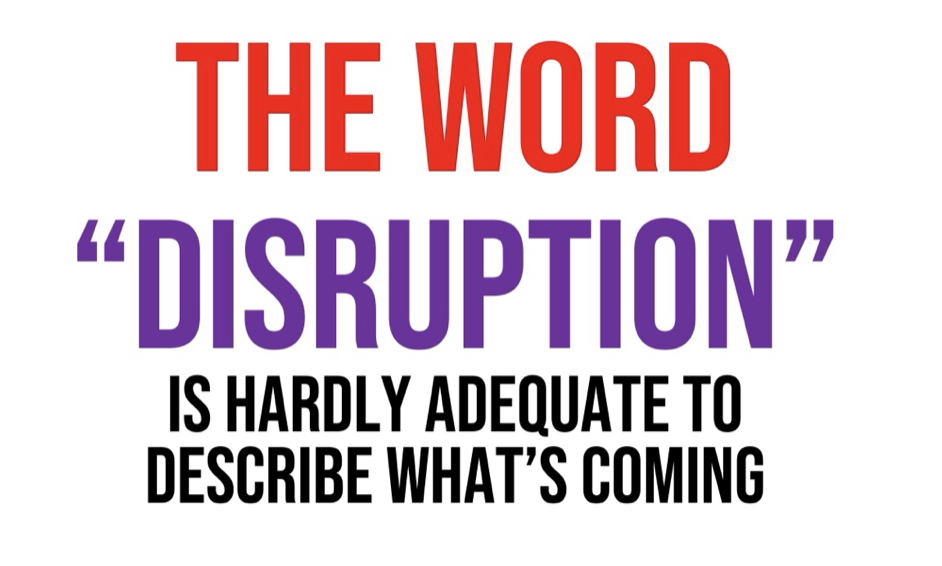
So we ask the question, “Are you ready?”
We can help you get ready, with workshops, keynote talks, and Crucible workflows to model the future of your industry. Ping us back - we’d be happy to support you.
Each edition of our newsletter reaches tens of thousands of readers. We’d love to have your feedback, so please let us know how we’re doing, and what you’d like to read more about in future editions. Thanks!