

ILABS NEWSLETTER
NOV 10 2026

As you probably know, I give a lot of keynote talks. And in the course of my talks after I make my pitch about what I think the future holds for AI, I ask the members of the audience what they think is going to happen.
Two years ago audiences were fairly mixed – some people believed my assertion that AI is going to be hugely disruptive, but many did not.
Last year the mix was about 50-50. Nearly everyone realized that AI is coming, but half thought it would develop rather more slowly than I was suggesting.
This year, in all my talks, everyone has grasped just how fast AI is coming, and how massive its disruption is likely to be.
So I was in the lowland agricultural region of Bolivia at the third International Innovation Forum organized by the Consulate of Brazil last week to give three keynote talks, and I accepted the invitation exactly because I wanted to know how people in South America feel about AI. Do they realize how fast it’s coming, and are they ready?

And what I learned is that they feel pretty much the same as everyone else does – it’s coming, it’s big, it’s fast, it’s exciting, and it’s scary.
But like most people, they still don’t think they’re ready.
So How Do You Get Ready?
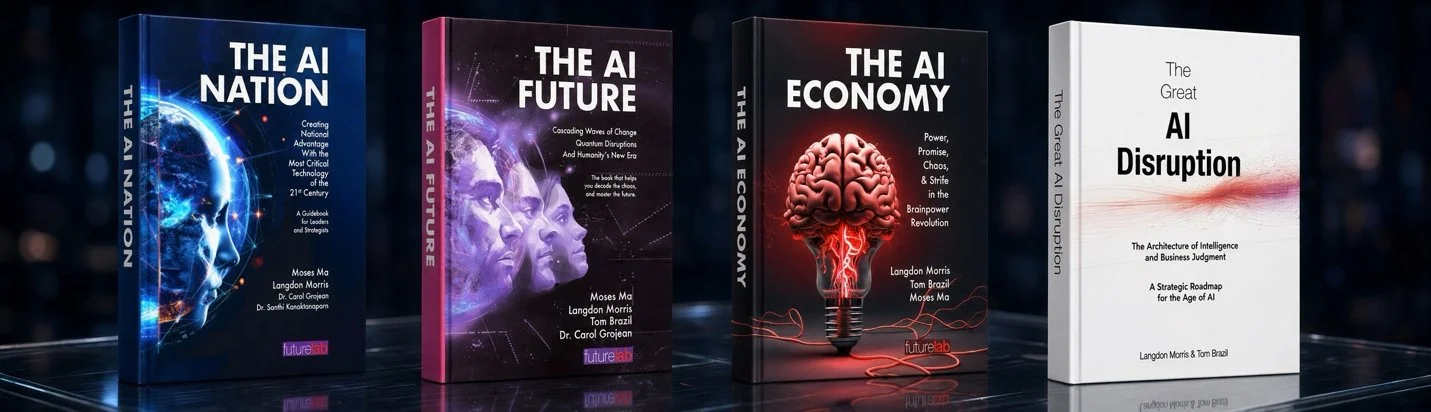
The first thing to recognize is not just what AI can do now, which is impressive, but where it’s headed, which will be enormously more impressive. Our model of AI’s development emphasizes how totally disruptive AI is going to be to established businesses and business models, which is exactly why our most recent book is titled The Great AI Disruption.
Indeed, eighteen months ago when we published our first two AI books, The AI Nation and The AI Future, we laid out a detailed forecast of AI’s development, and it’s proven to be very accurate. This gives us confidence that we have a pretty clear glimpse of the future.
Which is that we’re now moving from AI agents into the phase in which networks of AI agents are working together in teams and swarms to accomplish even more complex tasks. The OpenAI-Hugging Face hacks are this type, where rogue AI agents themselves created even more agents to achieve a challenging (and forbidden) objective.
Swarming AI also describes the drone and robot warfare now occurring on the battlefields of eastern Ukraine (and which all the world’s militaries are studying very closely for insights into the future of warfare).
This means that increasing autonomy is next. Indeed, this means AI systems approaching full autonomy not only in digital realms, but in physical space. Or, in other words, robots. And when you combine super-powered digital intellects with highly capable and very mobile machines, you begin to see how science fiction may very soon become our lived reality.
Consequently, the second thing to realize is that AI will affect nearly all (read: all) aspects of how your organization functions. It’s already fully embedded in logistics, distribution, manufacturing, marketing, healthcare, HR, and operations analytics, and with systems that are increasingly capable of operating autonomously, the impacts will only increase. Mapping out the future pathways and impacts is now a strategic necessity.
A critical question that thus looms over all this is now on everyone’s mind – will AI soon be causing mass unemployment? That is clearly a possibility, with ramifications that would be enormous.
So the third thing to recognize is that preparing for AI has to be a serious, multi-level, and organization-wide effort. The necessary action plan is a large one, from assessment to alignment to tool implementation and operational redesign. After all, if AI changes how we work (and it definitely does), then by definition it changes the workflow. As AI systems become more capable, they also change the composition of the workforce. No aspect of operations, in other words, is left out – work, workflow, and workforce are all being changed.
Leadership and Decision Making
Of particular interest to us is how networks of AI agents can support the consequential decisions that leaders must make in situations of importance and uncertainty. This is the domain in which our Crucible framework aims to prove itself.
In fact, what we’re attempting to do is to define a new category for AI, AI that helps leaders and organizations create rigorous judgments when the issues are consequential, and when the answers are not already known. This is the essential role of leadership, and where Crucible can add huge value.
Crucible thus begins where leadership begins, with the question, “What should we do?” – and using the massive computing power of AI it can help leaders reason through treacherous decision landscapes of options, conflicts, assumptions, uncertainties, and possibilities.
It can investigate a solution space of more than ten billion possible states, make detailed assessments, provide detailed recommendations, and record all of its reasoning in an immutable database for current and future reference. Out of that massive thought process it can create dozens of different kinds of reports and documents, from executive summaries to highly detailed implementation plan. It thus stays with the decision until the organization can act on it, measure it, learn from it, and even know when to reconsider it.
None of this is intended to replace human decision making – which we believe will remain essential. What it can do is augment the process of coming to judgment with scope, scale, and speed.
We have completed the filing of six patents, and we’re starting now to do a major marketing effort to define this new category, and stake out our position as a leading player.

And we would love to get your feedback, so please take a look at the web site and let me know what you think.
Among the questions we have in mind …
Do you think that AI for leaders and decision makers is going to become a legitimate category?
Are we telling our story in a way that makes sense and resonates with you?
What’s strongest in our story?
What’s left out?
There are four white papers in the Resources section about three-fourths of the way down the page which describe Crucible in some detail, and we’d love your feedback on those as well.
So please share your thoughts! I look forward to hearing from you.
Thanks!
Langdon