

AI and The Future of Healthcare
Will AI have a big impact in healthcare?
You already know that the answer is a resounding yes.

The likely scenario going forward is that the next few years will see the continuing transformation of all facets of care delivery, from genomics, drug discovery and development in labs, to diagnosis and treatment in homes, clinics, and hospitals, to analytics and strategic planning in executive offices.
Indeed, no portion of the care industry and the care continuum will remain untouched by AI, and instead all will be heavily impacted.
Nurses and doctors will use AI, even more than they already do now.
Patients will use AI too, a lot.
And so will insurers, governments, and health policy makers.
No one will be left out.
In our recent book The AI Nation, healthcare expert Fred Brown listed more than a dozen specific impacts that he foresees for AI.
“During the last five years alone, AI systems have advanced from managing hundreds of millions of parameters to over a trillion, meaning that their capacity to do pattern recognition is now far surpassing what humans can do alone. This leap forward isn't just about computational power, it’s about reshaping healthcare in all critical healthcare domains: suppliers, providers, insurers, and most especially, patients.”
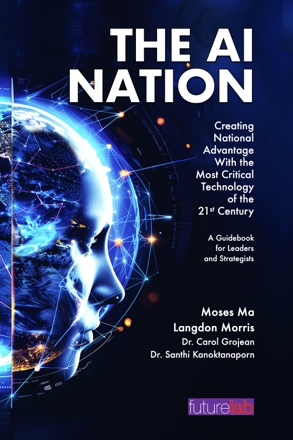
Fred foresees impacts across all facets of the healthcare continuum, including …
Care Delivery, through the development of precision diagnostics, digital biomarker analysis, AI-assisted surgery, dental implant design, and of course enhanced radiology.
Optimization of the Patient Experience through AI-assisted telemedicine, diagnostics, monitoring in the home, customized treatments, and support for mental health through techniques such as speech analysis, where AI can pick up signals too subtle for humans to notice.
Drug Development by accelerating drug discovery, development, and clinical trials.
Public Health will also be improved through the capacity to gather and assess enormous data sets across entire populations, linking data about behaviors, pathogens, environmental conditions, and genetics to anticipate and avoid major public health risks.
These are just some of the factors that AI is influencing now, and all will continue to change as AI gets better and more pervasive. The consequences are very clear: AI is changing the practice of medicine, and changing the delivery of health care, permanently.
So how should health care organizations prepare? How can you and your organization get ready? That’s the key question we examine here.
As with all major transformations in all industries, we can see the process of change occurring in two very different ways.
Option 1: Wait.
Stick to the tried and true and wait for the changes to arrive.
(And then get hit hard and overwhelmed when they hit.)
Option 2: Prepare (now).
Generate Awareness
Promote Engagement and Experimentation
Scale and Adopt
(We recommend Option 2.)
Here’s a quick look at what we’ve been up to in Option 2.
Awareness
During the last year Langdon delivered ten keynote speeches focusing on AI and the future. In all of them he emphasized the significance and progressive impact of AI, and helped people see what’s coming by explaining the development path of AI. He explored the consequences for individuals, organizations, and entire industries, and gave tons examples of AI today and tomorrow.
Here are some of the nice comments that people shared with us after Langdon’s talks:
“The speech of Langdon Morris stuck in my mind the most.”
“Incredibly convincing predictions by Langdon Morris.”
“Keynote from Monday by Langdon Morris. The most provocative keynote speech at an INCOSE conference in a long time.”
“It’s both exciting and scary to realize we are in the middle of another great revolution!”
Happily, people are indeed getting the message.
And here’s an interesting example of how awareness can lead to impact. Our friend Yves Caseau of Michelin recently told us that the company is saving more than €50 million annually due to its investments in AI throughout all facets of its operations. In 2024, Michelin earned a net profit of €1.9 billion, which means that the contribution of AI was materially significant for the health and vitality of the company. Yves is targeting €500 million in annual savings by 2030, a massive haul of savings that will help to provide the company with significant competitive advantages. In this way AI becomes strategically very significant, a key differentiator in fact.
And how did Yves get started on all this? In our conversation, which you can watch on our YouTube channel, he says that he simply “started playing around” with AI to become familiar with what it can do. That’s good advice for all of us.
Another Awareness strategy is the AI Summit. A few months we designed and facilitated a one-day summit meeting for a major national dental organization. We brought together experts who are already using AI in their dental practices to explore how AI is likely to develop in the coming years, and how best to prepare the dental office staff for what’s coming.
A set of very clear imperatives came out of the panel discussion and working sessions that helped a broad set of organizational leaders target their next key actions.
Engage
In our previous newsletter we highlighted the importance of AI Readiness, and shared the story of the Readiness Workshop we recently led for a major national healthcare organization, one with $100 billion + in annual revenue and a massive IT budget.
In the workshop we identified many key applications of AI across the IT organization, assessed where AI could have the most beneficial impacts, and developed a 30 – 60 – 90 day Action Plan to make it all real.
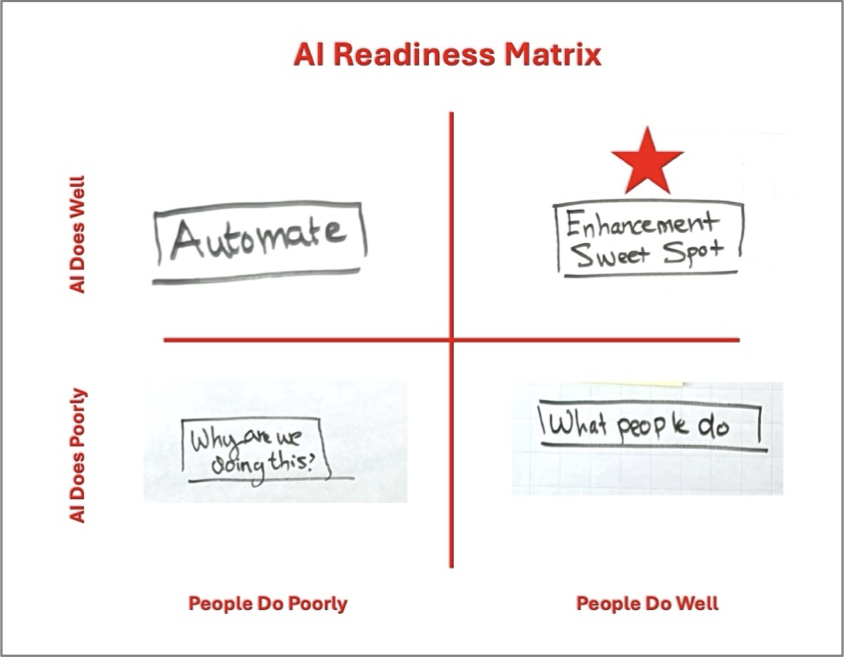
One of the tools we used in the workshop was a simple but highly effective 2x2 matrix that focuses attention on what AI is good at, what humans are good at, what they can effectively collaborate on, and what we should probably stop doing entirely. It’s a great way to focus on value creation and temper the hype with meaningful choices.
Scale and Adopt
Coming up in a couple months we’ll be leading a Strategy Summit for the Eastern Cape region of South Africa, to help business, government, and civic leaders throughout the region to “Seize the Future.”
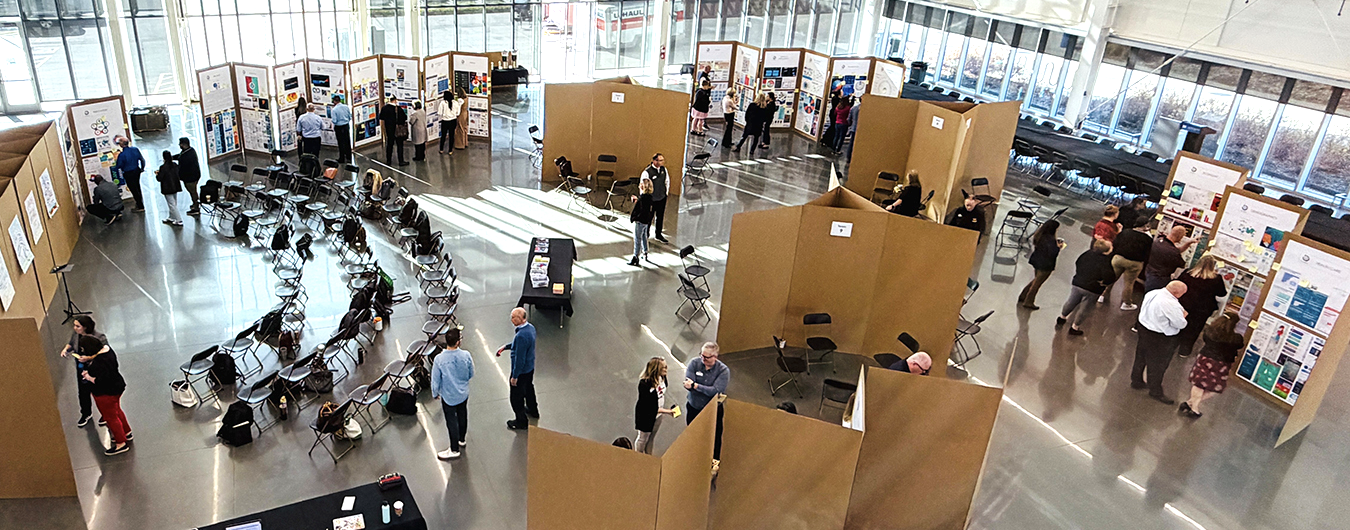
The region is going through a difficult time of major economic changes, and leaders there recognize that a proactive approach is what’s needed to make the policy choices that will lead to a prosperous future in a time of accelerating change.
A key tool we’ll be using in the workshop is our new Crucible Strategy Engine, an advanced agentic AI system that arrays an entire network of 22 AI agents to address and solve complex problems in business, strategy, and innovation.
We call it “McKinsey-in-a-Box,” because it can do the work of an entire team of high-level consultants. But a project that would take a month (or more) and cost around $1 million, Crucible can do in about 2 hours. Crucible reports provide 150 to 250 pages, extremely detailed strategic analysis and implementation planning.
So in the Eastern Cape session the humans will sort out the strategic situation and frame the key questions during the daytime, and then Crucible will take over in the evening and run its analysis and recommendations. The next day the humans will have a fully reasoned set of strategic options to assess, select, and plan for adoption.
In this way, what would formerly have taken around 180 days of preparation, analysis, planning, and action design can be accomplished in just five days.
More on Crucible
We are now licensing Crucible to consultants and enterprises, so please reach out if the capability to solve tough strategy questions in a matter of hours would be interesting for you. We’ll be happy to share our new white paper that explains the architecture of Crucible and describes some of the analysis work it’s already completed across key functions, such as …
How to run and manage an Oracle Cloud conversion
How to double the revenue of a consulting firm within a year
How to structure investment and reinvestment for a key regional industry sector.
As far as we can tell, Crucible is 18 to 24 months ahead of the market, so it’s likely that it could provide a significant competitive advantage to your organization.
As you can tell from all of the above, we’re dedicated to helping individuals and organizations successfully adapt to the new world that AI is rapidly bringing. Please get in touch if a keynote talk, a readiness workshop, or a Crucible project would help your organization.
•••
Our Recent Healthcare Expertise
InnovationLabs has developed extensive expertise across the entire healthcare continuum through many years of successful projects we have conducted worldwide. For most of these organizations we have completed multiple projects over the years, as we are their trusted partner when it comes to topics related to strategy and innovation.
Here is a short list of some of recent clients and their projects.
Accreditation Council of Graduate Medical Education (ACGME)
Partners Innovation Summit
American Board of Emergency Medicine (ABEM)
Partners Alignment and Innovation Plan
American Board of Medical Specialties (ABMS)
Specialty Boards Strategic Alignment
5 Year Strategic Plan
Scenario Planning
Innovation Master Plan
American Heart Association
Stakeholder Summit
Cardiac Care Treatment Innovation Plan
Covance
Innovation Master Plan
Dental Assisting National Board
Stakeholder Summit
5 Year Strategic Plan
Innovation Master Plan
Business Model Innovation
Keynote Talk
AI Summit
INCOSE
Keynote talk to Health Care Working Group (forthcoming)
Johnson & Johnson
Oral Care Innovation
Skin Care Innovation
Kaiser Permanente
Ten Year Vision
Hospitals Operations Transformation (15 hospital locations)
National HR Strategy
Predictive Analytics Innovation
CTO Office Alignment and Innovation
IT Project Management and AI Readiness
National Board of Medical Examiners
Innovation Master Plan
Optum / United Healthcare
Primary Care Delivery Transformation
Stanford Health Care
Operational Transformation
Care Delivery Strategy
Leadership Summit
UNICEF & World Health Organization
Global Polio Eradication Partners Summit
Training Program Design for Health Care Workers in Asia and Africa
•••
Image of David with sunglass: Brian Penny on Pixabay