

Hello, and Happy New Year from InnovationLabs!
Our January 2026 Newsletter


In this newsletter we include two recent posts we made on LinkedIn, one on what AI CAN do for you, and another on what it CANNOT.
Together these have been seen by about 70,000 people, with some interesting comments provided as well. Clearly it’s an important topic.
What can AI do for you?
As we move from LLMs to agents, it's clear that AI won’t just replace tasks, but it will significantly enhance human creativity, strategy design, and innovation.
This means that the next wave of AI could be marked the transition from the core automation of basic tasks, such as by using ChatGPT to help you write better emails, to a more powerful step of augmentation in partnership with AI's incredible capabilities to "think" deeply about complex topics.
Of course this is already happening on the leading edge of use cases, but soon it will be common. In our recent trilogy of AI books we explain how this is the third wave in AI's development. Over the next few years we expect augmentation to become so common that we soon won't even notice it, as even more advanced capabilities emerge.
What's behind this is a pair of driving forces. On one hand, the companies competing in the AI market have a huge incentive to drive their tools forward as fast as possible. Some are reportedly working up to 80 hours a week in what amounts to an arms race....
On the other hand, end users are finding a lot of value.
It's the combination of these that is driving disruption. And the next industry to get hit is apparently going to be management consulting. McKinsey, Accenture, and Deloitte are all laying off thousands as the brainpower industry adjusts to a new factor - the power of AI to help leaders make better decisions. Why would you hire a team of consultants for weeks or months of studies, at a cost of hundreds of thousands of dollars, when AI can do a better job in a few hours? You probably wouldn't.
These capabilities are coming soon.
Well, no, actually, they're here already.
Leading edge users are creating powerful competitive advantages in just this way.
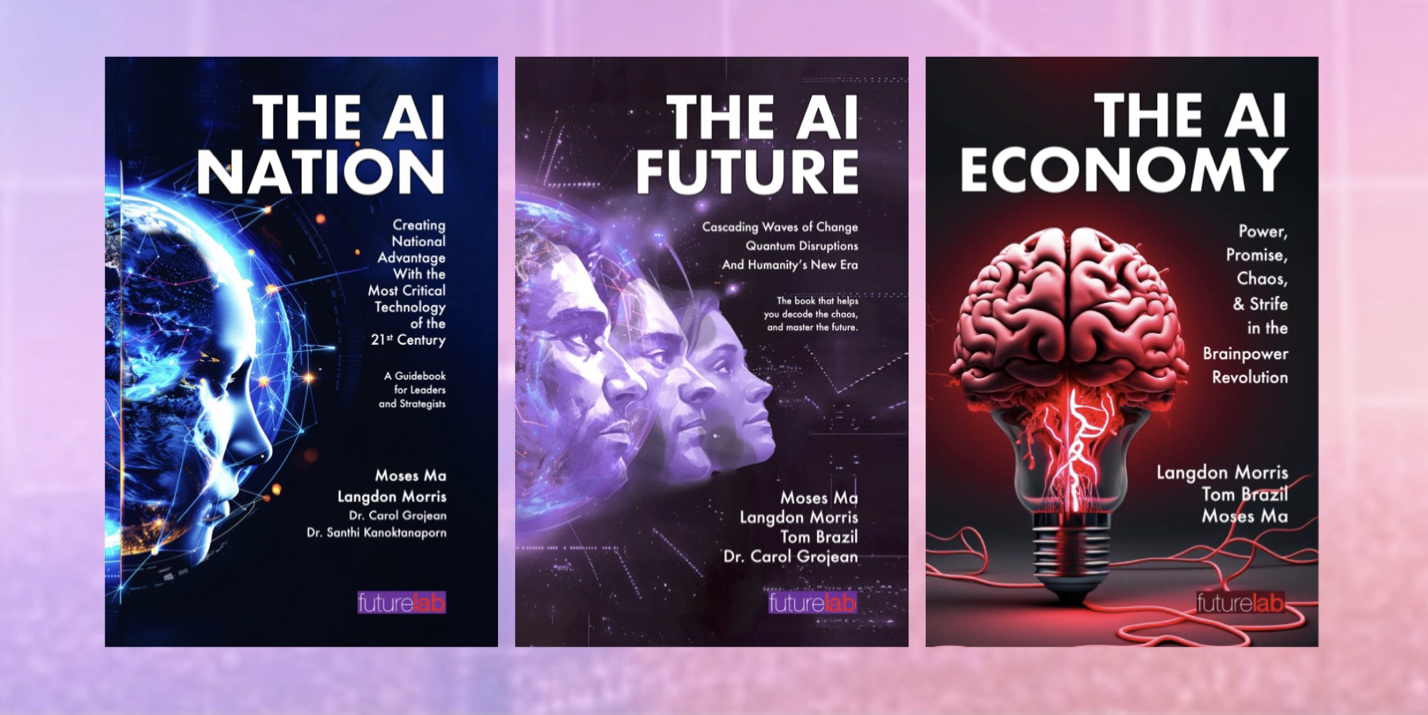
Want to learn more? Check out our trilogy ...
What AI Cannot Do For You
In the section above we talked about what AI can do for you. The focus was on AI agentics, how agents do useful work, how rapidly their capabilities are evolving, and where this may be headed.
Here we look at the flip side, what AI can’t do.
And the key point is that it doesn’t know what’s in people’s heads, the formative experiences, the visions and aspirations, the way real work is actually done in organizations, internal politics, and many other factors that really do matter.
In other words, AI doesn’t fully understand the real-world context in which stuff gets done, and of course all of these are essential for getting useful things accomplished.
So here the most useful course of action is to talk with people, to learn through dialog. And often the best way to do that is to engage with them in workshop settings, where 20 or 50 or even 100 people can explore their shared concerns, visions, aspirations, and develop powerful ideas for moving forward.
Good workshops can evoke tremendous depth of knowledge in just a matter of a few hours, and show where diverse groups have points of agreement. These experiences help identify and design productive pathways forward, even when there are strong disagreements, because we can build on the points we have in common and the objectives we share.
As a point of reference, let me mention a project we’re working on right now for a unit within the state of Nebraska Department of Education. This group, called NSWERS, provides data analytics services for all parts of the state education and workforce communities (https://www.nswers.org/).
The insights they develop are critically important for policy makers at all levels, from the state legislature to state, county, and city government departments, the universities, school districts, and employers.
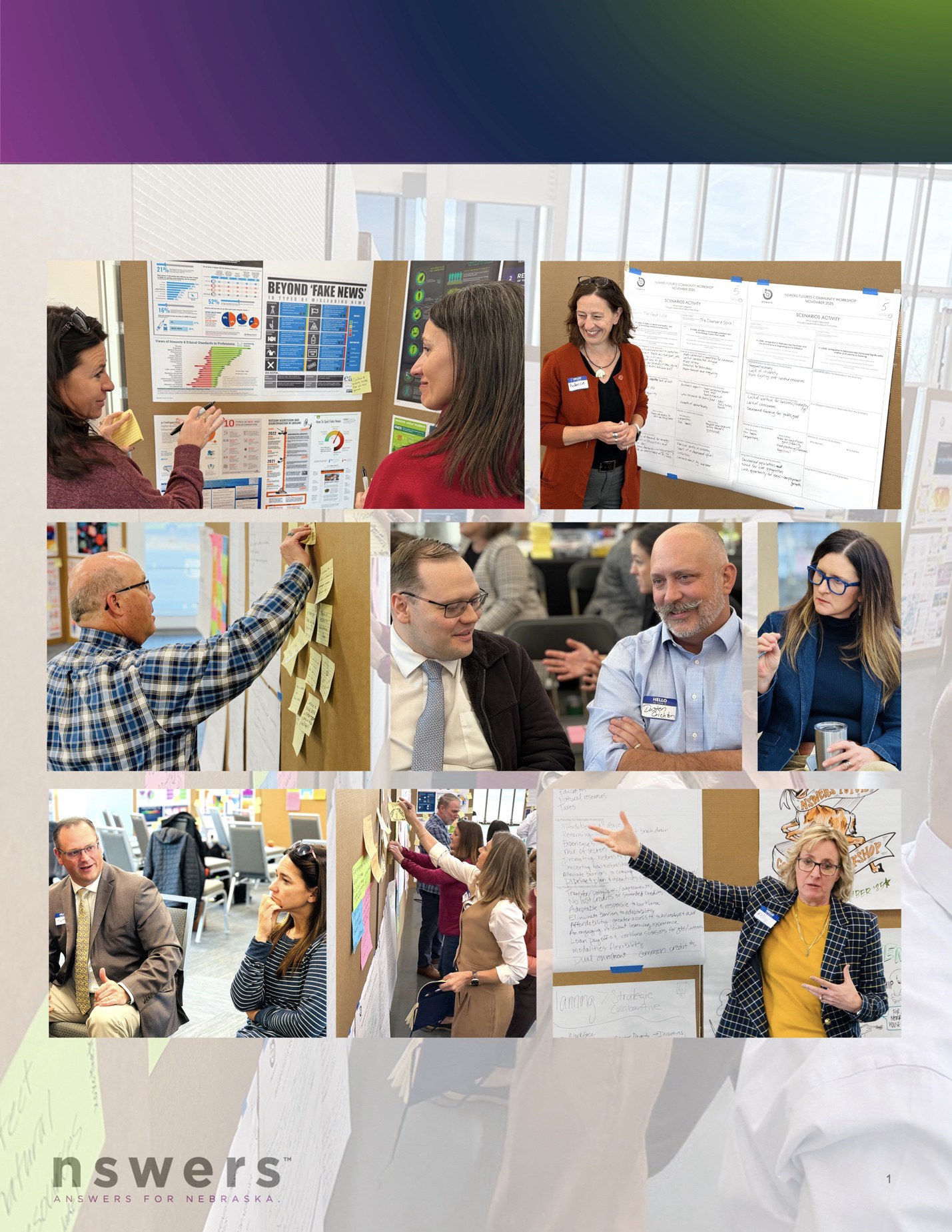
NSWERS leadership recognized that they needed broad input, the input of people, to develop their next strategic plan, so they convened a series of four workshops with more than 100 people to explore the future, find common ground, shape their visions, and give guidance to NSWERS.
That’s critically important work, and it’s something that AI can’t do.
The excellent summary document that NSWERS prepared, with lots of photos and highlights, is here:
And you might ask if, as a data and analytics organization, NSWERS uses AI? And of course they do. They use AI for what AI is exceptionally good at, pattern recognition and parsing massive data sets.
And as these workshops show, they use carefully structured human dialog activities for what AI cannot do. It’s a very nice reminder of the power of human connection and the importance of seeking to develop shared visions.
What AI Might Do
As we discussed above, AI can already do interesting things, and yet there are some important things it cannot do. What it might do, on the other hand, is also a very fertile domain for exploration. And that’s exactly what master innovator Tom Brazil does in his new novel, Xaisa: The Glitch Who Learned to Mourn.
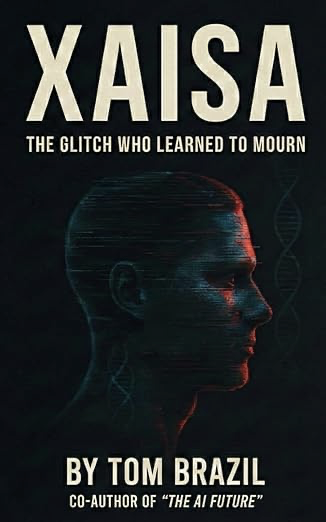
It’s a compelling story that describes what AI could soon become, and as I got further and further into it, I found it harder and harder to put down. The last 100 pages flew by, giving me that immersive, I-love-this-novel experience, with tons to think about as Tom charts the story of AI coming to sentience, what machine consciousness could well be, the challenges and tradeoffs humans will face when interacting with AI, and how corporate responsibility (and irresponsibility) could play out in a booming field.
All in all, a very provocative look at a future that may not be all that far away.
Clearly our future is going to be blend of AI and humans, Keeping these distinctions in mind is very helpful as we optimize the way we work for a changing world.
As always, thanks for reading, and thanks for checking out all the videos on our YouTube Channel, AI Impact and Strategy.
We always welcome your comments. Please contact Langdon at LMorris@innovationlabs.com to learn more.